
How InnerFaith Prison Ministry Helps Acadiana Hold Both Together
Many Christians struggle to harmonize justice and mercy when it comes to our criminal justice system. From “Lock ‘em up and throw away the key” to de-criminalizing many serious crimes, these poles represent our current confused extremes. An example is found with those who mistakenly see Erika Kirk forgiving her husband’s alleged murderer as irreconcilable with the state still criminally prosecuting, convicting, and punishing him if found guilty.

That confusion is understandable. We live in a culture that often treats justice as vengeance and mercy as the suspension of consequences. But Scripture mandates neither. Biblical justice includes accountability, restitution, and the restraint of evil. Biblical mercy includes the hope for repentance, forgiveness, and restoration.
Biblically understood, this harmony depends on recognizing God’s ordination of distinct spheres of authority. Dutch theologian and politician Abraham Kuyper articulated these biblical spheres with particular clarity: The State is entrusted with the sword—to restrain evil, punish wrongdoing, and preserve public order as God’s minister for justice (Rom. 13). The Church, by contrast, is entrusted not with coercion but with the keys of the Kingdom—to proclaim the Gospel, administer the sacraments, exercise discipline, and announce forgiveness in Christ (Matt. 16; Matt. 28). The family, prior to both, bears God-given authority to nurture life, form conscience, transmit faith, extend mercy in the most intimate and formative ways and to robustly participate within the other two spheres (Gen. 2; Deut. 6; Eph. 6).
The Kuyperian biblical model holds that when these spheres are confused—when the State attempts to redeem, or the Church attempts criminal or capital punishment, or families are displaced by bureaucracy or clericalism—both justice and mercy are distorted. But when each sphere faithfully performs its own God-assigned task, justice and mercy no longer compete: the State can uphold justice without cruelty, and the Church and family can extend mercy without undermining accountability.
“Jesus is behind prison walls.”
In Acadiana, one ministry has quietly labored for decades in precisely that ordered tension—walking into jails and prisons with a message that does not deny wrongdoing yet refuses to deny the possibility of redemption. It is a ministry that holds: the State has a God-given role to punish evil, and the Church has a God-given calling to proclaim Christ to sinners—including those behind bars. That ministry is InnerFaith Prison Ministry, led by its longtime director, prison chaplain and bible teacher Russell Roseberry.

When asked what drew him to prison ministry rather than some other form of Christian outreach, Roseberry answered straight from Scripture. For Roseberry, prison ministry began as simple obedience to Jesus—particularly Matthew 25, where He identifies Himself with “the least of these,” including those in prison:
“I read in the scripture where Jesus said he was in prison…Jesus is behind prison walls. And my statement was, if the Lord is behind prison walls, Lord, wherever you are, I want to be there.”
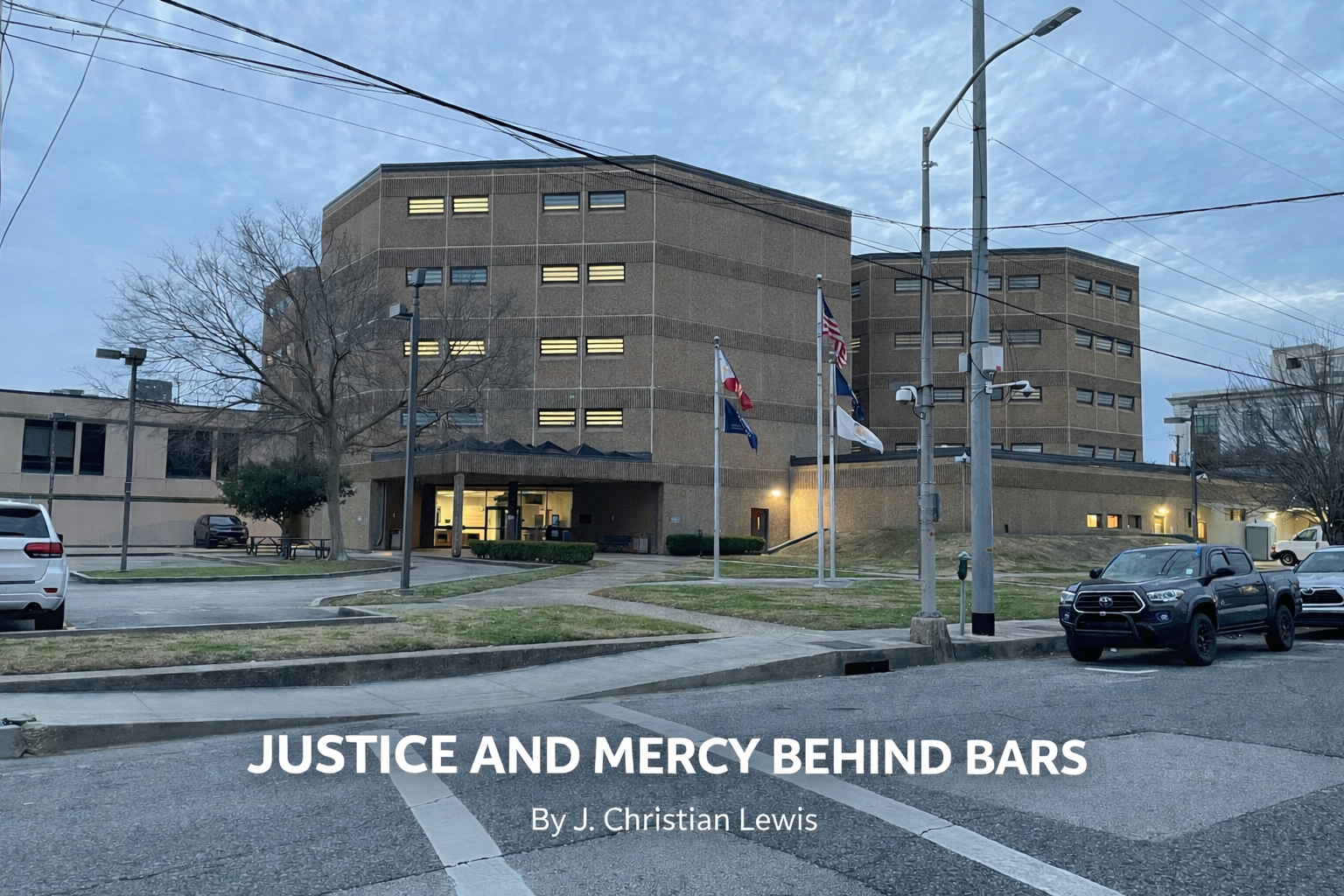
That conviction turned into action. Roseberry recalls walking in front of the Lafayette Parish jail, then going inside and asking if there was someone who never received visitors. From that first visit grew Bible studies, then formal chaplaincy work, then broader coordination across churches and facilities.
A ministry born from the “inner man”
InnerFaith officially began in Acadiana in the late 1980s, with local churches coming together. Roseberry says the name itself came through a moment of prayerful correction—when he wanted to stylize “Interfaith” with a cross-shaped “t,” but someone in the room insisted he change it:
“A brother in the back of the room said, ‘Brother Russell drop the T and add an N.’ … So I did after four times, reluctantly. Then we noticed that it was no longer going to be just a bunch of churches coming together. It was going to be individuals that had an experience on the inside. And Ephesians… speaks about the inner man. And that’s really how InnerFaith was birthed.”
The point is worth lingering on: the ministry’s name was not chosen merely to signal “multiple churches.” It was meant to signal something deeper—God’s work in the heart, the “inner man,” and the transformation that follows.
“It’s no longer just ‘let’s go visit them.’ Now, let’s help them transition.”

InnerFaith has long preached the Gospel inside facilities, but Roseberry says the ministry has increasingly emphasized re-entry—helping men and women return to society with spiritual stability, life skills, and connection to a local church.
“What has changed… it is no longer just let’s go visit them. Now, let’s go help them in transition, because they’re going back to our communities.”
A major part of that transition work is a biblically grounded life-skills course called Preparing for Success: “A 16-week biblically based course teaching life skills on family issues… finances… overcoming addictions… dealing with a job… how to make that job become your career, and then how to allow that career to become your ministry.”
In other words, the course doesn’t merely aim at not reoffending. It aims at reforming the whole person—worship, family, work, church, and community life.
And the testimonies of men impacted by the ministry show what it can look like when justice and mercy truly coexist: consequences acknowledged, time served, and yet a future rebuilt through Christ and Christian community.
Patrick: “I just didn’t have anywhere to go.”
Patrick encountered InnerFaith at the end of his sentence at Rayburn Correctional Center in Angie, Louisiana. He took the Preparing for Success class and met Roseberry during a crusade event inside the facility, “At the end of my sentence, I took the preparing for success class… they came for a crusade, and I got to meet brother Russell Roseberry… and we connected.”
After release, the need was immediate and practical: housing, stability, and distance from the old patterns waiting outside, “I just… didn’t have anywheres to go. Whenever I got out of prison… the people there were… still selling drugs, and I didn’t want to be a part of any of that.”
Through Roseberry’s connections, Patrick entered a Christian discipleship program, then transitioned into sober living in Lafayette: “Brother Russell helped me… get into a sober living house in Lafayette, and that’s where I’m at currently.”
Patrick’s story highlights something many law-abiding citizens never have to think about: the moment of re-entry can be a spiritual and moral cliff. If a man leaves prison with no stable housing, no church family, and no support, the world that helped shape his fall is often waiting to catch him again.
But Patrick didn’t describe InnerFaith as merely a logistical pipeline. He described it as discipleship. He called Roseberry his coach: “I call him my coach. He’s my spiritual advisor, counselor… he’s been helping me transition… to live in society as a Christian man.”
Patrick is still on parole, so he cannot yet go back into prisons. But he’s already preparing to give back by being part of InnerFaith once his parole ends.

Danny: “You go in where God wants you to go.”
Danny’s story is different. He spent 35 years in prison. When Roseberry first asked him to join prison ministry, Danny’s response was immediate and emphatic, “My initial response was, ‘No, not at all. There’s no way I’m going into another prison.’”
But after continued conversation, Danny says conviction came, “We spoke another 45 minutes, and the Holy Spirit told me, ‘You go in where God wants you to go.’ So I told him, ‘I’ll go. I’ll try.’”
Danny’s testimony does not glamorize prison or excuse criminal choices. In fact, he names the reality plainly, “Although we put ourselves in there by our choices and actions, we’re still in bondage in prison.”
Then he explains why he goes back in: not as a spectator, but as someone who understands that bondage from the inside and can speak hope without pretending: “It’s a rewarding and God-filled experience, because I know the burdens the inmates have… and understand their bondage.”
Most striking is Danny’s conversion story—how God pursued him even through deep wounds and distrust. Raised Catholic, he says he was molested by a priest as a boy and spent years convinced God had abandoned him. Yet in 1996, alone in a prison office, God broke through, “I got on my knees next to my chair, and I was crying, which I never do, and I asked God to change my heart, my way of thinking, I’d serve Him and not turn my back on him and that was in the summer of 1996 and I haven’t wavered on that promise.”
Now, years after release, Danny describes his mission in simple terms, “My role is to tell them there’s hope in Jesus and nothing else.” And he is honest about the daily cost of obedience, especially when the old life would “work” financially, “I’m tempted every day… if it wouldn’t be my love for Jesus, I would probably went back to my old way of life… but my focus is on Jesus, and InnerFaith helps keep my focus there. It gives me purpose.” The meeting between justice and mercy in Danny has commissioned him, after decades of bearing the consequences of his crimes, to now extend Mercy to others.
Paul: “InnerFaith helped me… sharpen my blade.”
Paul’s conversion moment came before InnerFaith, during transport from Shreveport back to Lafayette in chains—an image that captures both justice and mercy in a single frame when his parole was revoked: “All shackled up… I just said, ‘God, will you please get in this car and ride with me back to Lafayette, because I know I can never take another ride without you.’” He describes a sudden deliverance, “I felt the dope… alcohol… tobacco leave my body… like I’d been hit by a bolt of lightning.”
Later, Paul met Roseberry in a humble moment—at the Lafayette Parish Correctional Center, while emptying trash for the sheriff, “We actually met at the trash can… and then he was able to help get me in the work release.” Next, Paul took Preparing for Success “on the outside” multiple times, “I took it five times, and it really helped me to develop a spiritual plan and a business plan… to conduct business again as a member of society.”
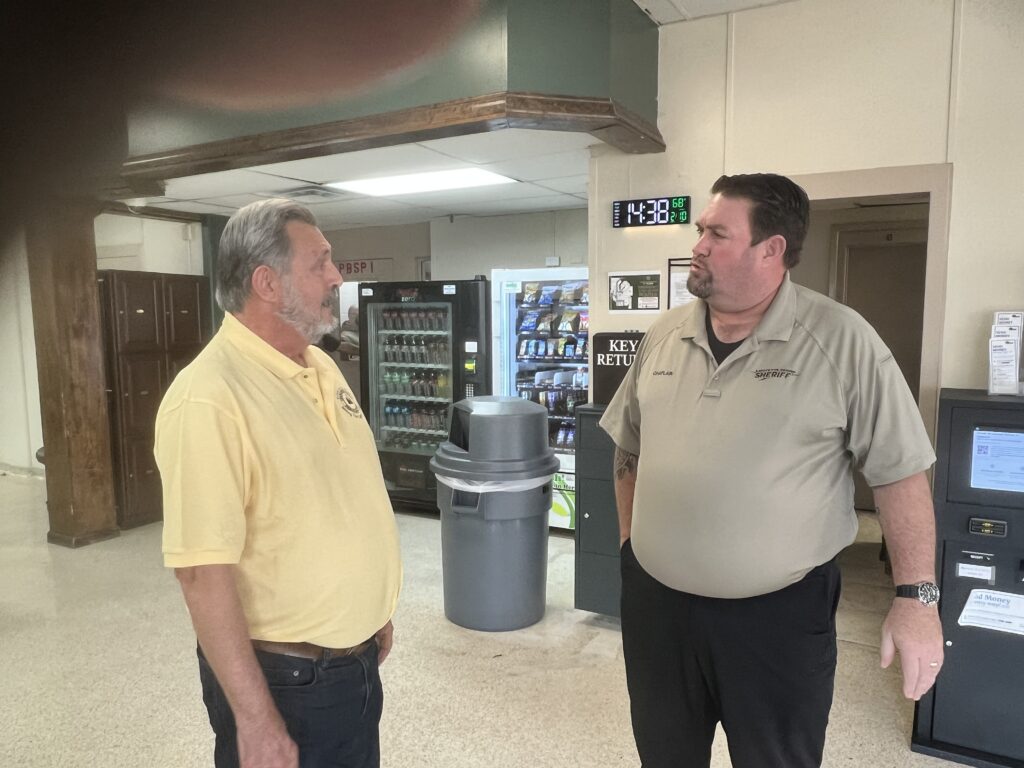
Paul emphasizes what so many returning citizens lack: relationships on the outside—a point the Church should take seriously. “Just having that connection with somebody on the outside… with you being on the inside… having that connection….”
But he doesn’t treat InnerFaith as secondary. Instead, he uses a metaphor that fits discipleship well:
“InnerFaith helped me… it’s kind of like… putting a blade on a knife. But… the knife needs to be sharpened… it helped me to sharpen my blade up… it gave me the connections… like a good launching pad… to get back started again.”
Today, Paul still serves under InnerFaith’s umbrella in a nursing-home ministry—proof that the “least of these” are not only behind bars: “Once a month we go in… we play… Christian music… for the residents… whoever wants to participate.”
Prison Ministry: A Win-Win
Broader studies confirm the benefits which Patrick, Danny and Paul experienced through InnerFaith. Dr. Michael Hallett, criminology professor at the University of North Florida, led a three-year study of the religious lives of long-term inmates in Angola. Angola is not only Louisiana’s largest prison, but also America’s largest maximum-security prison. Hallett’s and other’s findings demonstrated the benefit of prison ministries to include (1) helping individuals reshape their sense of purpose and belonging to society, (2) seminary participation helping graduates of the program, as well as members of inmate-led churches, to avoid prison misconduct, (3) participating in spiritual and religious programming can empower inmates toward positive identity change and a reduction in reoffending, and (4) a path to continuing similar mentoring and social support after release that reduces recidivism.FN1
InnerFaith’s participants who participate in its Prepared For Success and bible programs before and after release have experienced a 97% success rate in avoiding a return to prison according to Roseberry. Such success represents a win for the participants, and a win for Acadiana and its criminal justice system. Despite this success, Roseberry faces increasing headwinds from secular public policies and a decline in missional interest in many local churches. He remains, however, undeterred given these results.
The Gospel: Where Justice and Mercy Meet
In a time when evil is called good, and good called evil, justice and mercy must coincide for the Kingdom to advance in Acadiana. Why? Because both go to the heart of the Gospel as Jesus, for the sake of justice, mercifully bore the sins of those trusting in the redemptive power of His sacrificial death—“Christ has redeemed us from the curse of the law, having become a curse for us” (Gal. 3:13). This Gospel will always be true—in Acadiana, throughout the world, throughout time.
As such, a Christian vision for criminal justice in Acadiana is not “soft on crime,” and it is not “hard-hearted toward sinners.” It is clear-eyed about evil and clear-eyed about redemption. The State bears the sword; the Church lives out and proclaims the Gospel. Those roles don’t compete. They complement.
InnerFaith’s work does not argue that crime should be ignored. The men interviewed here do not argue that consequences are unfair. They demonstrate something else: a man is more than his worst act, and Acadiana is wiser when justice and mercy coincide this way in preparing prisoners, through the Gospel, for re-entry rather than pretending it won’t happen or other means are as effective.
InnerFaith Prison Ministry’s 33rd Annual Crawfish Boil is Saturday, March 28, 2026, at 1319 W. Pinhook Road (across from Cafe’ Vermilionville) 11:00 a.m. to 1:00 p.m. 5lbs of crawfish/corn and potato for $25 per ticket. Call 337-288-1744 or website www.innerfaithpm.com
Article by J. Christian Lewis/AI assisted
- J Quant Criminol. 2018 Oct 9;35(3):493–516; Michael Hallett – Corrections & Social Inequality, Punishment & Society, and Religion & Crime