
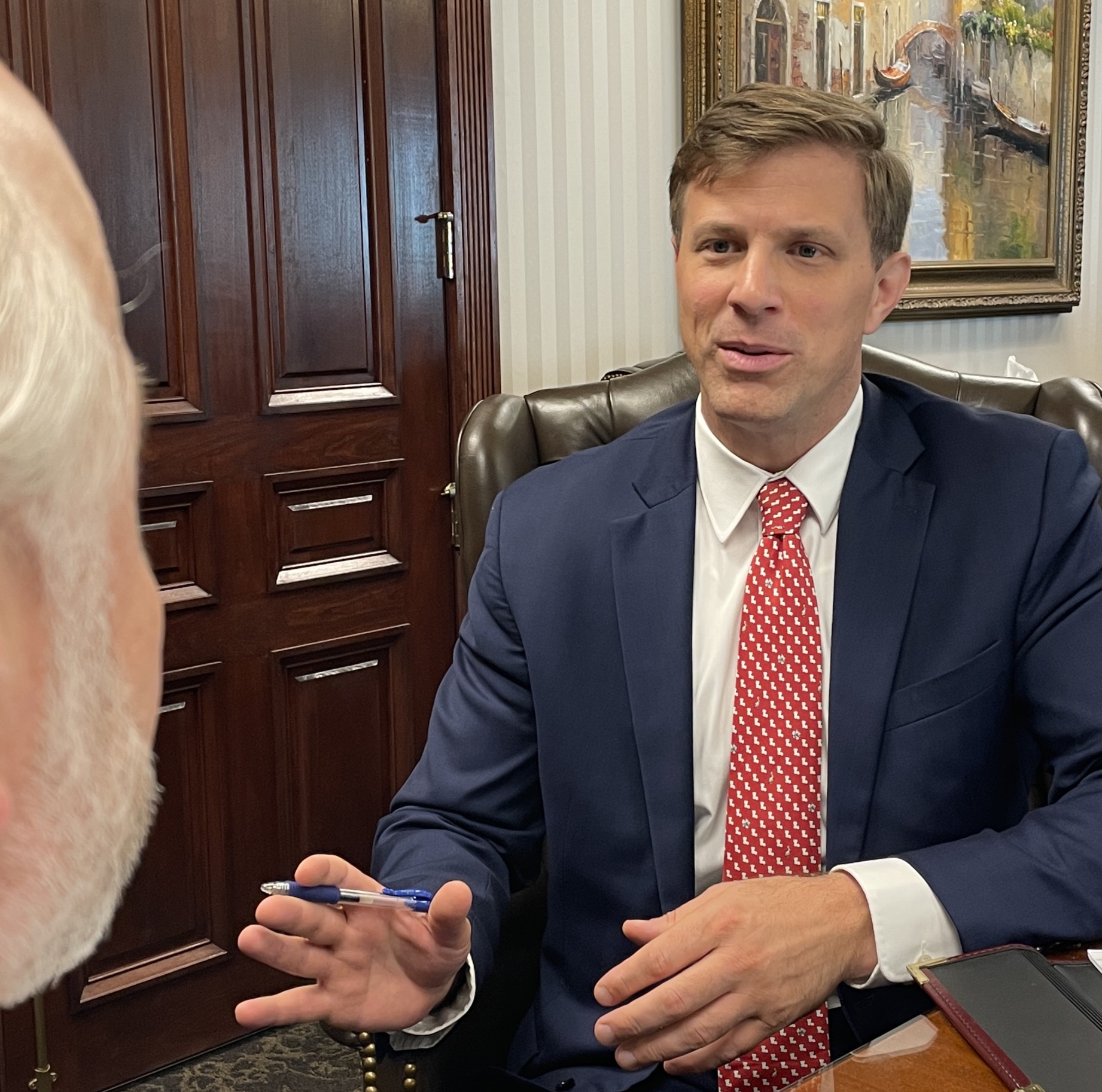
Talent, Providence and a Path Back to City Court
Editor: This is the second in Covenant Spotlight’s City Court candidate profiles. See April 16, 2026, profile of Emilia Pardo
In Christopher Nolan’s The Dark Knight, Harvey Dent wins over Gotham with seemingly everything required of a public servant: intelligence, confidence, charisma, toughness and an instinct for the courtroom. The newly elected district attorney becomes Gotham’s “White Knight,” the public face of its hope that law and courage might restore order.
Then life turns brutally against him. Dent’s tragedy is not that he lacked talent. It is that when suffering shattered the world as he understood it, he eventually surrendered his belief in moral order to chance.

James Klock has many of Harvey Dent’s talents. At 42, the Lafayette prosecutor is intelligent, personable, disciplined, politically comfortable and, by the accounts of lawyers who have worked beside him, unusually adept at the law. He has practiced on both sides of the criminal courtroom and now seeks the Division B seat of retiring Lafayette City Court Judge Douglas Saloom.
But Klock’s own story also includes a life-altering loss, a period of wandering, and a new path on which to use his talents. The difference is the direction in which that road appears to be taking him. Rather than toward chance, Klock increasingly speaks in the language of Providence.

“I can’t tell you how often Rebecca and I look at each other and say we were meant to be here,” Klock said of his fiancée, attorney Rebecca Guidry, and the unusual convergence of marriage, faith and his campaign for judge. “We were put here for a reason.”
Whether Lafayette voters ultimately believe that road should lead to the City Court bench will be decided in November. But the path itself helps explain the candidate asking them to put him there.
Klock was born in Alexandria and grew up knowing that his father, Gene, was sick. Before his teenage years took a more difficult turn, Klock’s childhood included the kind of structured institutions that would later become important again in his life. He was active in Scouting and in church at St. James Episcopal.
Heart problems and strokes meant hospitalizations were sufficiently common that Klock remembers awakening to find neighbors or friends staying with the children while his parents were at the hospital.

When Klock was 15, the event the family had long feared finally came. His father died. Klock does not romanticize what happened next. He describes “growing pains” involving academics, discipline and his relationships with others. There were periods, he says, when “school became optional.” Looking back as an adult, he also sees more clearly what his mother was carrying: a schoolteacher who had lost her husband while trying to guide two teenage sons.

His path through high school reflected the disruption. He began at Bolton High School, spent a semester living with family friends and attending Mandeville High, and eventually finished high school at an all-boys military boarding school in Kansas. Klock is careful not to credit the school with magically transforming him. He describes it instead as a structured environment that allowed him to learn that accomplishing larger goals required him first to meet certain responsibilities.
The deeper change took longer. Asked when he finally became the focused person others now describe, Klock jokingly answered: sometime in his “mid to late 20s.” That admission is important to understanding him. The candidate now asking voters to entrust him with young people appearing in City Court was once a young person struggling to find his own direction.
Before his father’s death, one of the constants in Klock’s childhood was St. James Episcopal Church in Alexandria. Church was not merely an hour on Sunday. Klock remembers Sunday school, worship, youth group on Wednesday evenings and the social life of a congregation that functioned almost like extended family. His mother incorporated faith into family life, including giving thanks around the dinner table. After retiring from teaching, she eventually became secretary at St. James.
Klock’s lifelong friend Chris Wilder remembers the same world. Wilder met Klock when the boys were around 10. They attended St. James together, participated in youth group and were Scouts together. Their lives separated at times after Klock left for boarding school, but the friendship endured into adulthood.
Yet Klock’s adult faith has not been an uninterrupted continuation of childhood churchgoing. His story is better described as a return and a deepening. Klock says prayer has again become part of the ordinary rhythm of his life and that he sees his work itself as a form of service.
Guidry sees something deeper than religious habit. “I think it’s his relationship with Jesus,” she said when asked what she believes lies behind Klock’s character. She points particularly to his mother, whom she describes as a woman of strong faith and prayer who instilled that foundation in her son.
Klock’s professional trajectory did not begin with a childhood master plan to become a judge. After boarding school, he returned to Alexandria without much direction. Eventually he enrolled in college. A formative experience came not in a courtroom but while observing Louisiana’s Board of Regents.

Klock remembers being fascinated by watching people use public institutions to accomplish things on a scale larger than themselves. What interested him, he says, was not power for its own sake but “the mechanics” of how people could produce change.
That curiosity led him into student government at LSU Alexandria. He became student body president and eventually the student representative on the Louisiana Board of Regents. Exposure there to lawyers involved in public life helped point him toward law school and a profession through which he believed he could serve others.

Wilder remembers watching that transformation. The childhood friend describes Klock as intensely disciplined and steadfast. He also remembers campaigning for him during his LSU Alexandria student-government race and watching the once-directionless teenager develop an appetite for public service.
That appetite eventually brought Klock to Lafayette. He opened a solo practice and obtained a public-defender contract in the very court where he now hopes to serve as judge. His practice expanded into criminal, family and immigration matters. In 2019, the Federal Public Defender’s Office recruited him to close his private practice and work full-time representing federal defendants in the Western District of Louisiana. In 2022, he moved to the other side of the courtroom and became a prosecutor.
Klock says he does not view those roles as requiring different conceptions of justice. “I’m the same person now as a prosecutor that was a defense attorney,” he said. “I’m trying to get everybody in the best situation possible moving forward.”
Attorney Travis Mose knew Klock when Klock was the new lawyer in Lafayette City Court. Mose had considerably more experience and initially took the younger attorney under his wing. He soon discovered, however, that Klock did not require much time to learn the court.
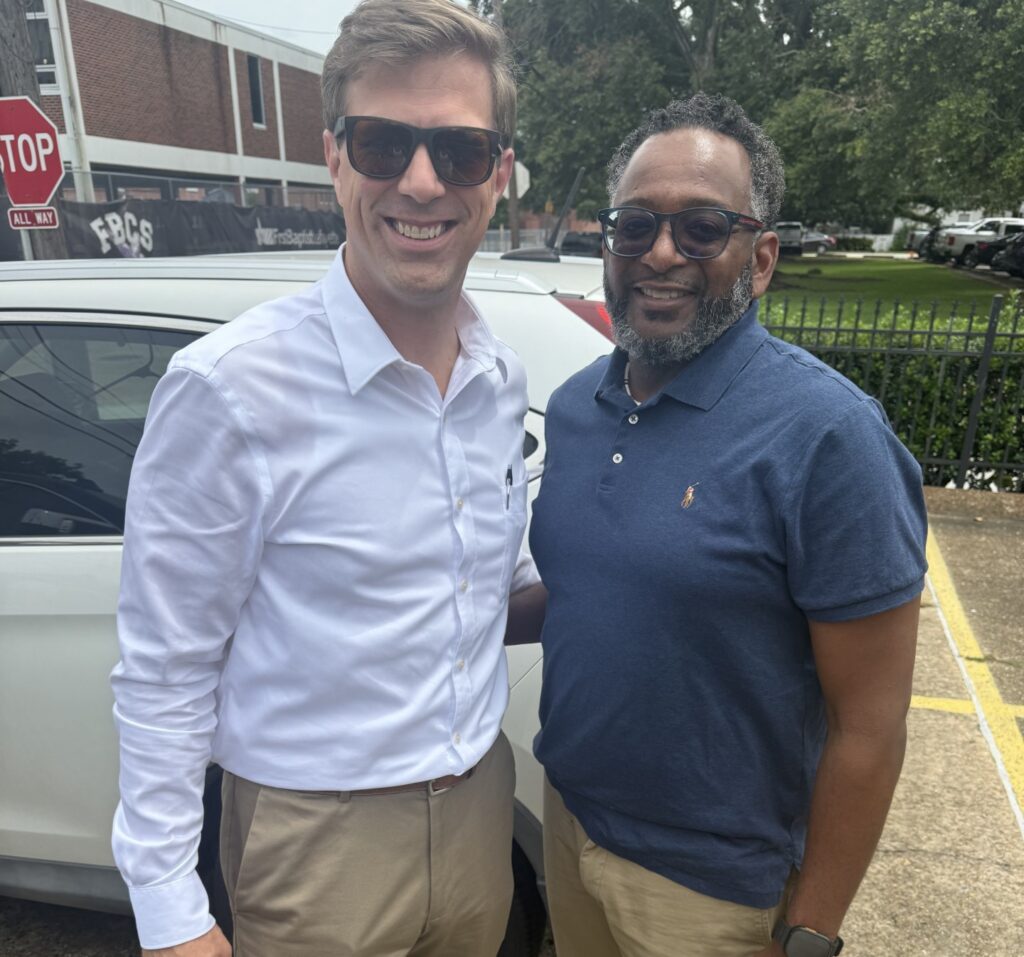
“He was just such a quick learner,” Mose recalled, saying Klock was ready within a remarkably short period to handle what the City Court docket demanded.
Years later, Mose’s assessment has only strengthened. He describes Klock as intelligent, disciplined and caring, but particularly emphasizes the way he deals with people. “He really cares about people, and all people,” Mose said. One story illustrates the point. Mose recalls hearing from lawyers and law-enforcement officers about a public-defense client who had disappeared and stopped appearing for court. Concerned about what had happened to him, Klock reportedly went looking for the man himself, found him and helped get him back on track. Mose knew this was work far beyond what a public defender was being paid to do. For him, that mattered.
Wilder tells a similar story from outside the legal profession. Years ago, Wilder was struggling to launch a small business. Klock was hardly wealthy himself. Yet Wilder remembers Klock as the one person willing to invest financially in him. “He wrote me a check of money I knew he couldn’t afford to give me,” Wilder said. The assistance did not end with money. Klock contributed time, ideas, physical labor and support. “I’ll never forget it,” Wilder said. It is why Wilder describes Klock as someone whose relationships are not transactional. After more than three decades of friendship, he says Klock is someone he can call when there is nothing Klock stands to gain in return.

Then, in the fall of 2025, another unexpected turn occurred. Guidry, herself an attorney, spotted Klock at a continuing legal education dinner. Her first impression was straightforward: he was good-looking. Then he answered a legal question by drawing a connection between two seemingly unrelated areas of law. Her assessment expanded. “Wow, he’s also really smart,” she remembers thinking. She noticed his Festival International socks, maneuvered herself into the same group leaving the event, connected with him on LinkedIn, and Klock asked her to brunch the next day. They are now engaged.
For Klock, the relationship has coincided with a renewed seriousness about faith. For Guidry, faith has become central to how the two understand their future. They pray together before meals, meetings and campaign events. They are visiting churches together while deciding where they will eventually establish themselves as a family.

Guidry also sees a connection between Klock’s childhood and the court he now seeks to lead, “He just has a heart for youth who have kind of lost their way, because that’s where he was for a while,” Guidry said. She believes City Court offers an opportunity to “help people get back on the right path” before their problems become serious enough to bring them into state or federal court.
For Klock, that is part of the attraction. He talks about treating the people who enter the courthouse with dignity, giving them an opportunity to be heard and looking for practical ways to make the court accessible to people whose lives do not fit neatly within government office hours. Among the ideas he has discussed is limited flexible scheduling for people who otherwise must choose between appearing in court, working, attending school or being home when their children arrive. Those are campaign ideas, not accomplishments, and voters will have to evaluate them along with the qualifications and proposals of the other candidates. But they fit Klock’s larger story.
That brings the comparison back to Harvey Dent. Dent’s great vulnerability in The Dark Knight was not a shortage of talent. It was the foundation beneath it. After unbearable loss, the man once presented as Gotham’s champion comes to believe that morality itself is little more than illusion. He finally entrusts judgment to chance and the flip of a coin.
Klock’s life has moved in the opposite direction. His father’s death at 15 did not immediately strengthen him. By his own account, it helped send him into years in which discipline, education and direction were uncertain. The path from there to law school, public defense, federal practice, prosecution and now a judicial campaign was neither straight nor inevitable. Neither was the path from the church-centered boyhood of St. James to his present effort with Guidry to make faith central to the family they hope to build. Klock does not claim to have arrived at the end of that journey. What he does increasingly claim is that the turns themselves are not chance or outside of Providence.
Klock says Christ provides the example by which he understands what is good and how a person should live. “God, Christ has given us the example on the path to follow,” he said. “It’s up to us to walk in it.” That conviction may be the most consequential contrast with Nolan’s fictional district attorney. Harvey Dent had the résumé, intellect, presence and ambition to become Gotham’s White Knight. James Klock possesses many of those same tangible qualities, according to the people who have known him as a child, friend, colleague and future husband. But talent alone is no guarantee of wisdom, justice or perseverance. Klock’s story instead raises a different possibility: that the losses and detours of a life can become part of its preparation, and that a man who once lacked direction can come to see his path not as a series of random turns, but as something being directed beyond himself.
Whether that path leads to the Lafayette City Court bench will be decided by the voters. Klock, at least, knows he has not been led here merely by chance.
J. Christian Lewis/AI assisted