
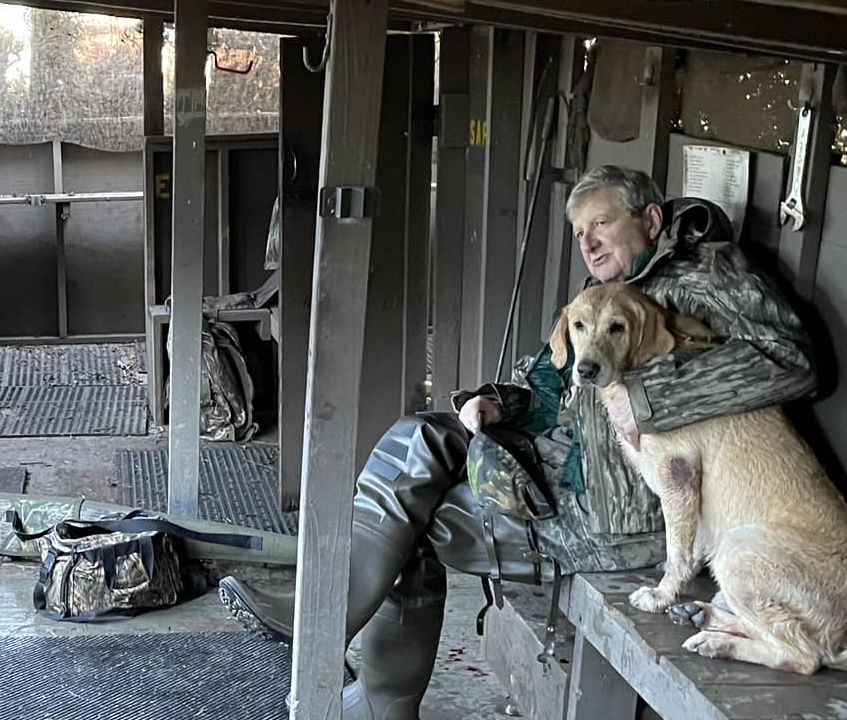
LAFAYETTE, LA — There are two kinds of silence. One is the quiet that brings peace, while the other brings anxiety.
For nearly twenty-five years, Louisiana’s duck hunters have lived with the second kind: the anxious silence that comes when something is missing, when something is wrong.
Blinds are still built while fathers still bring their sons and grandfathers still bring their grandchildren. But something peculiar has gone missing—ducks. The question of why has lingered for decades, spoken in sporting goods stores, at boat launches, and increasingly online, but rarely beyond hushed conversation—Until now.

When U.S. Senator John Kennedy sent a letter on January 6, 2026, to the U.S. Fish and Wildlife Service requesting a comprehensive study into how modern agricultural practices may be altering waterfowl migration, the response was swift and loud. Critics and supporters alike rushed to air their differences. Through the noise, the purpose of the letter itself was lost.
Senator Kennedy did not advocate a moratorium on flooded unharvested corn.
It was not a ban on any legal hunting practices.
It was a request to examine what many have privately suspected.
The decline of dabbling ducks in Louisiana is no longer subtle. For more than two decades, hunters across the state have watched duck seasons consecutively decline with mornings pass without taking their guns off of safety, all during what were once peak winter months for waterfowl. Mallards, gadwall, and wigeon—cornerstones of Louisiana’s waterfowl tradition—have largely vanished from skies where they once migrated by the hundreds of thousands.
That loss has not gone unnoticed at home.
Despite the echoing silence from conservation organizations like Ducks Unlimited, a growing number of Louisiana hunters have come to the same conclusion: this is not simply a bad stretch of weather or a run of poor breeding years. Many now recognize that the increasing commercialization of waterfowl hunting—particularly the rise of destination-style hunting over artificially concentrated bird populations on legally manipulated agriculture—has altered the sport in ways that favor for-profit organizations and personal gain over sportsmanship and duck distribution.
What was once a shared public resource has, in practice, become increasingly privatized.

It was in that context that Senator John Kennedy sent his letter. It asked for something many locals have wanted for years: a comprehensive, science-based examination of whether modern agricultural practices—specifically the increase of large-scale flooding of standing crops like corn—are altering historic duck migration patterns along the Mississippi Flyway.
The response within Louisiana was swift and supportive.
State legislators, councils and parish governments across Louisiana have already publicly voiced support for the request. The consistency of that support, from coastal rice country to central and northern Louisiana, underscores a shared recognition that the problem is not isolated to one region or one group of people.
For many, the letter represented the first time in a generation that someone with national standing articulated what they had been observing firsthand for years.
That inquiry must begin with a critical distinction, one that frames the entire debate: Population is not migration.
Breeding Numbers
One of the central misunderstandings surrounding public debate regarding Senator Kennedy’s letter is the distinction between duck numbers and duck migration. As provided by the U.S. Fish and Wildlife Service, continental waterfowl populations are shaped primarily by breeding success, wetland availability in the Prairie Pothole Region, predator dynamics, and long-term climate cycles– all things Senator Kennedy mentioned in his letter. Migration, however, follows a different logic. Ducks do not migrate south because of weather alone; they move based on photoperiods and food availability. As Kennedy fully acknowledged:
“Duck migrations have always been based on a multitude of factors, including varying winter weather patterns, wetland health, hunting pressure, and breeding trends—but failing to address the evident change in migratory behavior of a waterfowl population already in serious decline would fall short of the stewardship the resource desperately requires.”
This principle is long recognized by the USFWS and supported by decades of peer-reviewed research. That distinction matters. Humans have limited control over weather and breeding success, but enormous influence over food availability.
Regulating large-scale agricultural practices, particularly the intentional flooding of standing, unharvested crops, are among the few levers at a regulator’s disposal that are capable of altering migration behavior. As duck numbers in the prairie pothole region have declined from 47 million in 2017 to 34 million in 2025, increased scrutiny has fallen on the USFWS Adaptive Harvest Management system, which has maintained a liberal bag limit and season structure since 1997. The continued silence surrounding “duck farming” practices that commodify and exaggerate the vulnerability of a natural resource already in decline is precisely what Senator Kennedy’s letter addressed: whether agriculture and concentrated duck populations are reshaping the historic distribution of ducks along the Mississippi Flyway.
That question alone was enough to provoke outrage.
The reason is simple: the answer may implicate many who have taken advantage of these practices to hold, concentrate and kill waterfowl for financial gain.
Still, critics argue Louisiana’s decline is simply the result of poor breeding years that began in 2017. The data directly contradicts that claim.
As Louisiana’s big ducks began to decline in 2000, the Prairie Pothole Region experienced some of the most productive waterfowl breeding conditions in recorded history. From roughly 2009 through 2016, USFWS Waterfowl Breeding Population and Habitat Surveys documented sustained, above-average duck production, culminating in an all-time continental population high in 2015.
Duke Lowrie, Chairman of the Bossier Parish Republican Central Committee and Managing Director of Flyway Federation captures the distinction succinctly:

Louisiana did not see a return on that investment.
The state’s duck decline began 15 years before the all-time peak of waterfowl production and persisted through years of record breeding success. From 2000-2015, the mallard harvest fell from 452,842 birds in 2000 to 38,490 in 2015— a 91.5% decrease. Rather than suffering a decline, states like Missouri maintained stable harvest levels throughout the same time period and saw increases by 2015, underscoring a stark contrast with states farther south along the Mississippi Flyway. That timeline matters. It demonstrates that breeding abundance is not causative to Louisiana’s migration failure.
“You can have record breeding numbers and still have a migration failure. Senator Kennedy understands that difference.”
The Decline Was Never Just In Mallards
The disappearance of mallards from Louisiana is undeniable and among the most overwhelming facts of this debate. U.S. Fish and Wildlife Service harvest data and band recovery records indicate the state has lost approximately 95% of its historic mallard migration since the mid-1990s. But focusing solely on greenheads obscures the full scope of the decline.
Gadwall, American wigeon, and other dabbling ducks, species once abundant across coastal and interior Louisiana, have declined in near-lockstep with mallards. These birds share a critical trait: they are highly responsive to carbohydrate-dense foods such as corn.

Few people have watched this transition more closely than Paul Yakupzack. Over a 35-year career with USFWS, including 11 years as manager of Cameron Prairie National Wildlife Refuge, Yakupzack witnessed Louisiana’s dramatic shift.
“When I started, Louisiana was a destination,” Yakupzack says. “We held birds through the winter. Over time, that changed. And the biggest shift wasn’t just habitat here—it was how food was being provided elsewhere.”
Scientific literature supports his observation. Studies published in the Journal of Wildlife Management consistently show that corn provides one of the highest net energy returns available to dabbling ducks, allowing birds to meet daily caloric needs with minimal effort. When those resources are artificially concentrated, migration patterns respond.
This pattern matters because it isolates the cause. Habitat loss within Louisiana has not selectively targeted dabbling ducks while sparing divers; nor has weather discriminated by feeding strategy. The species that declined most sharply are those most capable of exploiting concentrated agricultural food sources elsewhere.
Yakupzack also cautions that migration distortion does not occur in isolation. Liberal season frameworks, he argues, have failed to adequately account for declining breeding success—particularly among hens.
“You can’t manage ducks on abundance alone,” Yakupzack says. “Hen survival is the foundation of everything. When you lose that, no amount of habitat or food will fix it.”
He has long supported shorter seasons, more conservative limits, and frameworks grounded in long-term reproductive trends rather than single-year population highs. Without addressing both migration distribution and hen survival simultaneously, Yakupzack warns, managers risk turning a distribution problem into a future population collapse.
“It doesn’t get cold enough”
In Kaplan, Louisiana, Brodney Mouton, now in his seventies, has hunted ducks through cold snaps, warm winters, droughts, floods, and everything in between. He has seen great seasons and lean ones, early pushes and late flights. He understands variability. What he does not recognize is today’s absence.
“At my age, you’ve seen it all,” Mouton says. “Cold years, warm years—it never looked like this.”
In Pecan Island, his father once guided during what locals still call the golden age of Louisiana duck hunting. As a boy, Brodney watched flights pour into the marsh in Vermillion Parish—wave after wave of ducks finishing into the decoys. Limits of mallards and pintails were harvested on most days throughout the season, usually in short-sleeved shirts. Today, most mornings are quiet.
While dabblers have become almost nonexistent, what have not disappeared are diving ducks and teal. Only dabbling ducks, the species most responsive to flooded row crops, have been consistently short-stopped.
Climate data reinforces what Mouton already knows. NOAA and IPCC assessments show average temperatures across the Mississippi Flyway have risen approximately 1.3–1.6°F over four decades, with even smaller increases during peak migration months. If weather were the driver, changes would be gradual and universal.
Instead, Louisiana’s decline was abrupt, species-specific, and geographically aligned with food concentration farther north. While weather influences timing, it does not erase migration.
Some argue that “it doesn’t get cold enough” for big ducks to migrate to Louisiana. What they are really saying is that less than a 1°F increase over the last 25 years is responsible.
The Illusion of a Healthy Harvest
Louisiana’s duck season is often defended by pointing to total harvest. But harvest statistics—particularly HIP survey data—mask more than they reveal.
Lifelong hunter and professional dog trainer Dane Benoit of Thibodaux, LA has watched the shift unfold. As local dabbling ducks disappeared, Louisiana hunters began traveling elsewhere, leasing land and booking hunts in Oklahoma, Arkansas, Missouri, and the Dakotas.
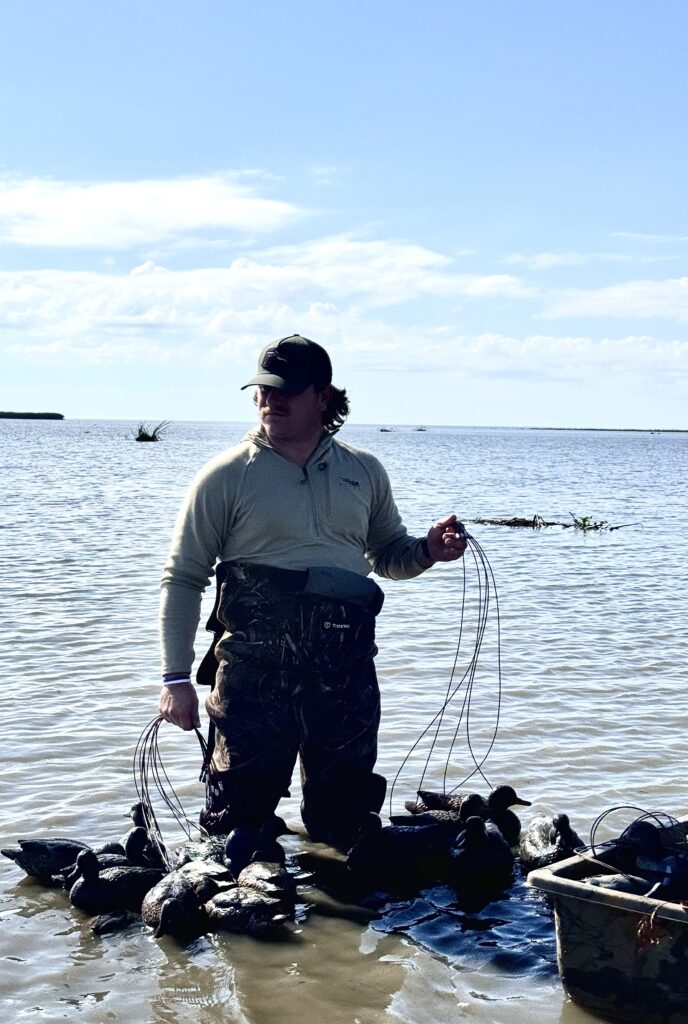
“The birds are still getting shot,” Benoit says. “Many of them just aren’t getting shot here.”
Louisiana Department of Wildlife and FIsheries utilize the Harvest Information Program (HIP) to ask hunters to self-identify which migratory birds they hunted and roughly how many days they hunted in the previous season.
Ironically, it does not measure bird harvest or where birds were taken because HIP is only a registration and sampling tool, with harvest totals and location data collected later from a marginal subset of surveyed hunters, not at certification.
More critically, Louisiana’s waterfowl surveys rely on transect methods developed decades ago—when ducks were broadly dispersed across wetlands, not concentrated into small, artificially managed landscapes. Ducks are now highly concentrated in movement, and applying the same multipliers that once adjusted for wide dispersion introduces error.
When LDWF waterfowl manager Jason Olszak reported over a million ducks in Louisiana in November, many hunters doubted it. The methodology, which assumes birds are spread across the landscape, fails to reflect reality when ducks cluster.
Entire transect lines that once held hundreds of thousands of ducks now sit empty, not because birds no longer exist, but because they no longer distribute the way they once did. Survey methodologies have not evolved alongside duck behavior.
There are numerous reasons Louisiana harvest and survey numbers are suspect. What is not suspect are band recovery data, long-term economic declines tied directly to waterfowl absence, and transmitter data that track where ducks actually concentrate today.
Even when approaching duck-data with an open mind, recent USFWS harvest estimates now show that green-winged and blue-winged teal now comprise roughly 46–48 percent of Louisiana’s total duck harvest. Without teal, a bird many hunters have historically overlooked at first light while “waiting on big ducks”, Louisiana’s duck harvest would effectively be cut in half. That is a very dangerous place for a flyway to be.
Teal have quietly become the backbone of the state’s waterfowl harvest, and their outsized role exposes how fragile the system has become. Now that Louisiana has effectively operated under a 60-day teal season in practice, even these populations have declined, resulting in a 9 day September teal season. When the one species that carries half the harvest begins to slip, it is a serious warning sign.
Legal Baiting: What Changed in 1999?
Nowhere in Senator Kennedy’s letter did he claim that flooding corn was illegal before 1999. That argument exists only in reaction.
What changed in 1999 was not legality—it was certainty.
Prior to 1998, enforcement of the Migratory Bird Treaty Act treated baiting as a strict-liability offense. While hunting over standing, unharvested crops such as corn was not illegal, hunters and landowners faced uncertainty: if stalks were bent or grain was found in water, the burden rested with property owners to prove they had not knowingly hunted over a baited field. This uncertainty discouraged risky practices that brought stiff penalties. The 1998 Migratory Bird Treaty Reform Act eliminated the strict liability standard.
In 1999, the USFWS issued a final rule (64 Fed. Reg. 29799) clarifying what constituted “manipulation” of crops and defining which agricultural practices—including flooding unharvested crops—would not be considered baiting under the new standard. The rule did not create new rights or behaviors, but formally removed ambiguity around practices that had long been legal, confirming that hunting over flooded, standing crops had always been permissible under federal law (64 Fed. Reg. 29799).
The rule did not mandate new behavior—but it normalized what was already a legal practice. This is what Senator Kennedy was referring to when he emphasized that the Final Rule “removed the enforcement mechanism that previously restricted the growth of hunting over intentionally flooded standing crops.” USDA Census of Agriculture data shows a sharp expansion of acreage dedicated to hunting over flooded corn in states such as Missouri following the change.
Once capital entered the equation, incentives shifted from holding birds briefly to holding them indefinitely. Migration ceased to be a natural process and became, in some regions, a managed outcome.
Policy did not invent short-stopping, but it did enable it. Flooding standing crops did not suddenly appear in 1999. “Legal baiting” and agricultural flooding existed well before the 1998 MBTA revisions and the 1999 Final Rule. What changed was not the practice, but the confidence to dramatically expand it the last 25 years.
The law has left many to wonder: if a hunter can’t put corn in water, why can he put water on corn?
Density, Disease, and Consequence
Artificial concentration carries consequences beyond migration. Dr. Mark Merchant, a PhD biologist at McNeese State University, has repeatedly warned that dense congregations of waterfowl create ideal conditions for disease transmission—particularly avian influenza.
“When you artificially concentrate birds, you increase contact rates dramatically,” Merchant explains. “That’s how viruses spread.”
U.S. Geological Survey (USGS) wildlife health surveillance data show that avian influenza viruses circulate widely in wild waterfowl populations and that understanding their prevalence in reservoir species is critical for detecting and managing disease risk within wild populations (USGS, 2025).
Concentrations of waterfowl on refuges and other managed areas with flooded row crops, such as corn, create conditions where large numbers of ducks and geese share limited space and resources, increasing opportunities for virus transmission. USDA and state outbreak reports have repeatedly documented avian influenza detections in wild birds, confirming that artificial concentration amplifies disease risk.
Concentration trades natural resilience for hunting efficiency while negatively impacting the health of the wild avian population.
Private Property and Public Trust
Some argue scrutiny of agricultural practices represents government overreach. But migratory birds are not private property. While some argue about what the law should be, they overlook what the law is concerning private property in the United States.
Under the “Commerce Clause” of the U.S. Constitution, agricultural commodities are regulated across state lines. Under international treaty, migratory birds are held in trust for the public after overharvest from market hunters drove North American waterfowl to near extinction during the early 20th century.
Pursuant to the 5th Amendment “Takings Clause”, the government can do as much as take private property, so long as just compensation and due process are afforded. It was James Madison and not bureaucrats in D.C. who wrote the Bill of Rights. Senator Kennedy is not arguing for anyone’s property to be taken or exclusively controlled by the government. The question is whether holding tens of thousands of ducks over legally baited fields aligns with the conservation ethic that has governed waterfowl management for over a century.
The same reason a landowner can only legally shoot 6 ducks in a morning instead of 600 on “private property” is the same reason why that same person should not artificially concentrate hundreds of thousands of ducks for 60 days of the year.
The law already recognizes limits. Senator Kennedy is asking whether current “duck farming” practices have exceeded them.
Corn and Rice Are Not the Same
Some critics have opposed Senator Kennedy’s letter in a familiar refrain: in the vein of Reagan’s warning—“I’m from the government, and I’m here to help”—they suggest that if bureaucrats scrutinize corn, rice will inevitably be next.
Rice flooding, however, is fundamentally different. It is an agronomic necessity tied to crop production, harvest timing, irrigation cycles, ratooning and secondary crawfish farming. Rice is harvested well before peak duck migration usually between July and October while subsequent flooding serves agricultural purposes, not waterfowl manipulation.
Corn, by contrast, is increasingly grown, flooded and left completely unharvested solely to attract and hold waterfowl. USDA Census of Agriculture data document a sharp rise in acreage dedicated to this practice in key Mississippi Flyway states, particularly Missouri and Arkansas, following the 1999 regulatory clarification. What was once incidental —ducks benefiting from leftover wastegrain or standing corn in dry fields—has now become intentional: corn is planted, flooded, and managed to manipulate waterfowl distribution, creating dense, high-energy food concentrations that significantly alter historic migration patterns.
Research from the Cohen Wildlife Lab (Jan. 13, 2026) demonstrates the outsized influence of flooded corn on mallard behavior in West Tennessee. Just 3,000 acres of corn produce roughly 86 million duck energy days—about 13 times more than traditional wetlands and nearly two-thirds of what Louisiana’s entire coastal wetlands are expected to provide annually—concentrating vast numbers of birds in a small area. Mallards show a pronounced pattern: they roost on refuges during the day and feed on flooded corn at night, making them effectively nocturnal in response to hunting pressure and the predictable availability of high-energy food.
Sanctuary fields see continuous 24/7 use and rapid depletion, while hunted fields are generally avoided during daylight, leaving significant food late into the season. These findings highlight how artificial food concentrations dramatically alter natural behavior, flight patterns, and habitat use, with duck use days revealing an alarming shift: waterfowl are increasingly commuting and feeding nocturnally, illustrating the profound ecological impact of corn on migration and local distribution.
While one farming practice in Louisiana incidentally benefits ducks, the other is designed entirely around them. Conflating rice and corn obscures their agricultural purposes and misses the central reason Louisiana hunters are now facing drastically reduced duck numbers.
Habitat Loss, a Half Truth
Habitat loss is often cited as the primary cause of declining duck numbers in Louisiana. There is no question that wetland drainage, coastal subsidence, and urban development have reduced some historically available areas. Yet the state still offers massive and productive waterfowl habitat. The Atchafalaya Basin alone provides roughly 1.2 million acres, supplemented by several hundred thousand acres of state-run Wildlife Management Areas, coastal marsh refuges, river tributaries, flooded timber, and roughly 400,000 acres of rice fields (USDA/NASS, 2024).
Despite this, many of these areas now lie largely empty. Surveys and band recoveries indicate that prime locations that once supported hundreds of thousands of mallards, gadwall, pintail, and American wigeon through the winter are now dramatically underutilized. If habitat loss alone were the main driver, these vast and productive areas would still attract significant numbers of birds.
Yakupzack explains:
“You can manage habitat all you want, but for waterfowl, you can’t manage what you don’t have anymore. It’s not just about the habitat, it’s about the food and duck-use days.”
Modern agricultural practices, particularly the artificial concentration of food through flooded standing corn along the Mississippi Flyway, have reshaped duck migration. Ducks are not avoiding Louisiana because the habitat is gone—they are responding to concentrated food sources north of the state.
While habitat loss is real and remains an important conservation issue, it is secondary to the impacts of artificial food concentration and shortstopping practices. Senator Kennedy’s letter shines a light on these practices, asking whether they align with the long-term health of the flyway and the traditions of Louisiana waterfowl hunting.
Why the Letter Matters
As Senator Kennedy often does, he did not introduce a new idea. He acknowledged an obvious one by saying what everyone else is already thinking.
For years, Louisiana hunters, biologists, and communities have quietly recognized the elephant in the room. Ducks did not disappear by accident. They were incentivized to stop.
Senator Kennedy simply had the courage to say it out loud. That national conversation was overdue. And Louisiana was ready to start it.
Read Kennedy’s letter here: 76C1075FE143F7B8CB9EE5E9A1EAFF0919C538632EB2C4E6977FF2DDA739B8C6.senator-john-kennedy-letter-to-usfws—waterfowl-baiting-1.6.26.pdf